
Last updated November 2, 2026
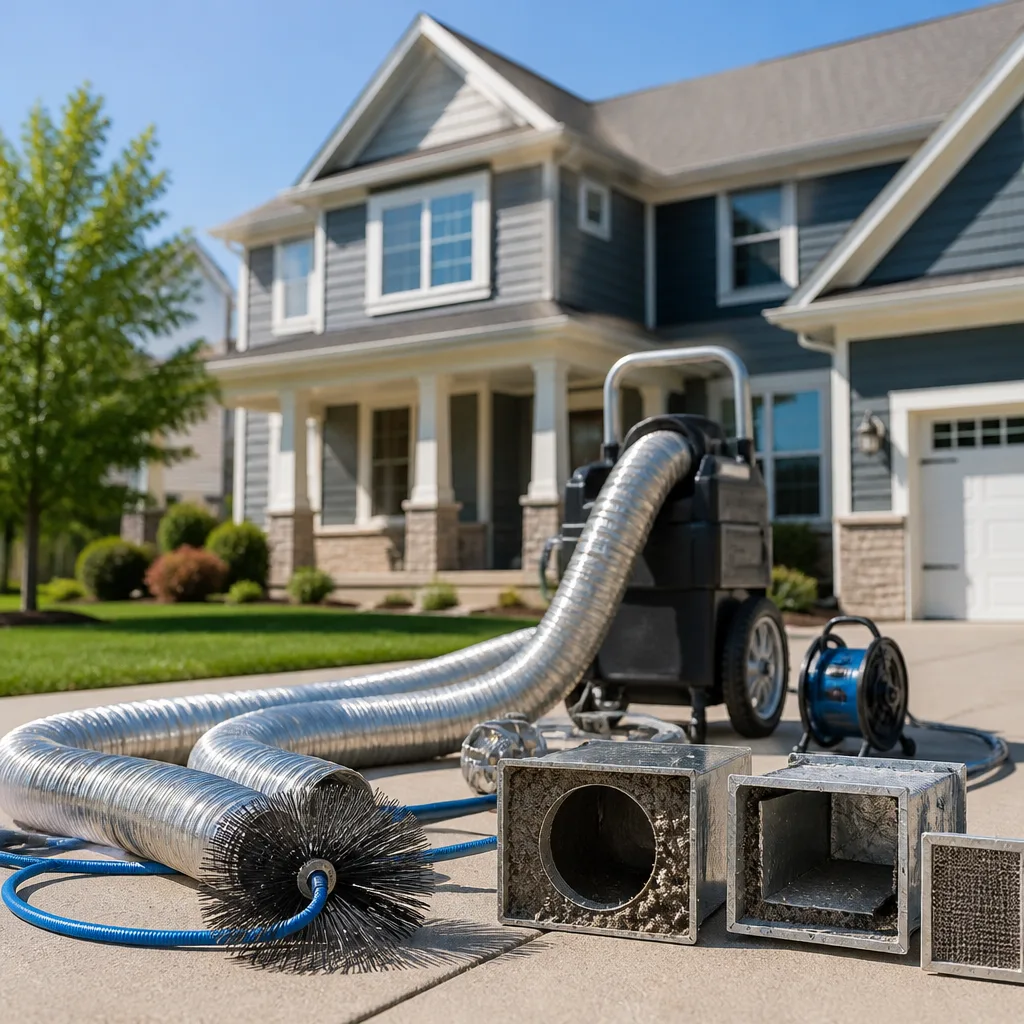 Whole-home duct cleaning
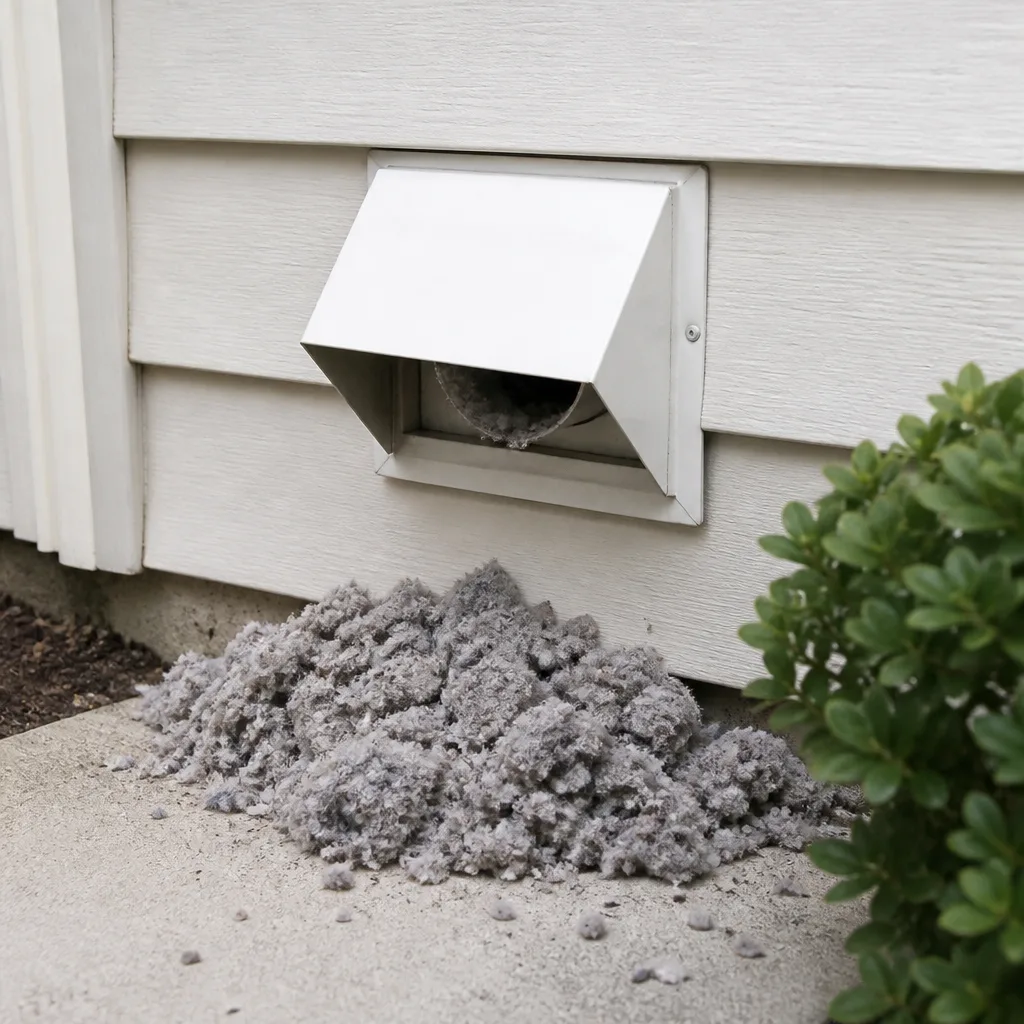 Dryer vent cleaning
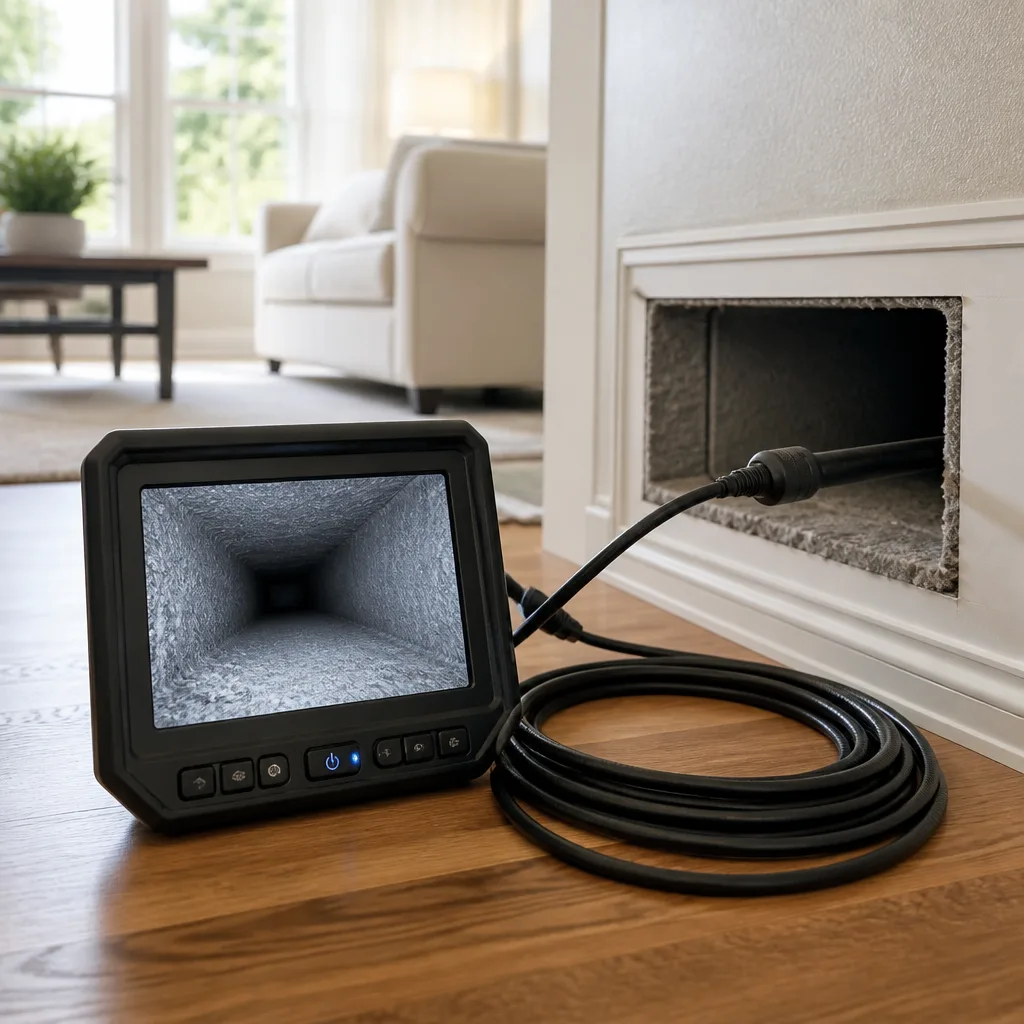 Camera inspection
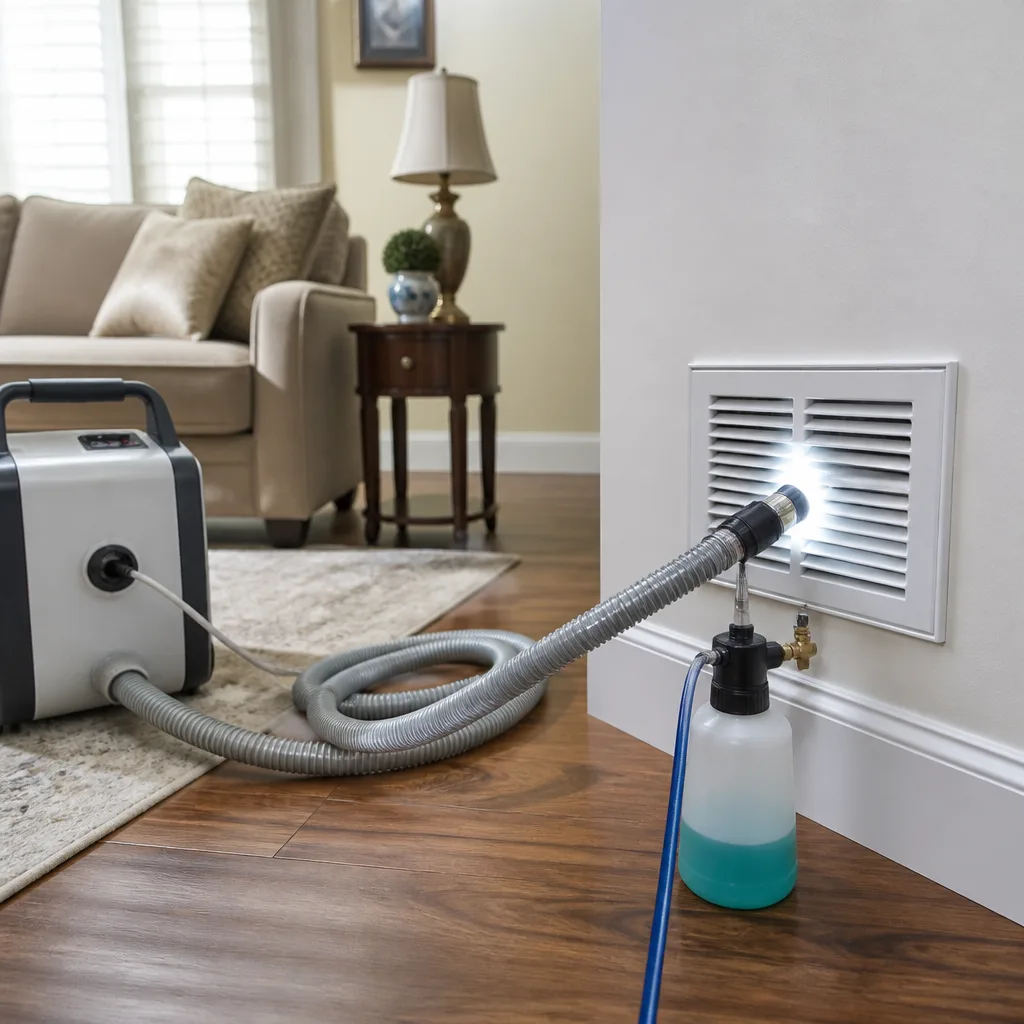 Sanitizing & deodorizing
Whole-system duct and dryer vent check with before-and-after photos - you see exactly what came out of your vents
That "$99 whole-house special" is a bait ad - the real number appears once they are in your hallway, or the "clean" is a shop-vac at the register. We photograph the inside of your ducts before and after instead.
Air Duct Cleaning Permits, Codes & Inspections in CA: What You Need to Know
Here’s the counterintuitive reality that most homeowners in La Habra never hear from a contractor: air duct cleaning itself does not require a permit anywhere in California. No city issues one. No county inspector signs off on one. But the moment a technician cuts into your ductwork to patch a hole, replaces a section of collapsed flex duct, or reroutes a run around a new wall, that “cleaning” visit has legally become a mechanical repair job, and California code says it needs a permit, a C-20 license, and an inspection. This guide explains exactly where that line sits, why it matters for your liability as a homeowner, and how to know whether the service you’re paying for is actually legal.
Styles & brands we work with
- Whole-home duct cleaning
- Dryer vent cleaning
- Camera inspection
- Sanitizing & deodorizing
Quick Answer
Air duct cleaning is not a permit-required activity in California, but duct repair, replacement, or modification is. Any work that alters, replaces, or reconfigures ductwork falls under the California Mechanical Code and requires a mechanical permit from your local building department. Cleaning alone, performed with negative-air or mechanical agitation equipment, sits outside the permit system entirely. The confusion between these two categories is where homeowners get into trouble.
Table of Contents
- Where California Draws the Line: Cleaning vs. Repair
- The C-20 License: What It Is and Why It Separates Cleaners from Contractors
- What a Mechanical Permit Actually Involves in La Habra
- Title 24 and Duct Sealing: The Code Overlay Most Homeowners Miss
- South Coast AQMD Rules: What Can and Cannot Go Inside Your Ducts
- Mold in Ductwork: When Cleaning Becomes Remediation
- Property Disclosure: What You Must Tell a Buyer About Duct Work
- Common Mistakes to Avoid
- When to Call a Professional
- Frequently Asked Questions
- The Bottom Line
Where California Draws the Line: Cleaning vs. Repair
California’s regulatory framework for ductwork is surprisingly clean-cut once you understand the operative verb. Cleaning is defined as the removal of accumulated dust, debris, and microbial growth from the interior surfaces of a duct system without altering, cutting, replacing, or reassembling any component. Repair is anything that changes the physical structure of the system. That single distinction drives everything: permits, licenses, liability, and insurance coverage.
The California Mechanical Code (CMC), which is Title 24, Part 4 of the California Code of Regulations, governs the installation, alteration, and repair of duct systems. Chapter 3 of the CMC requires a mechanical permit for any work that modifies a duct system’s configuration, materials, or connection points. Cleaning equipment that enters through existing access points and leaves the system intact is not “modifying” anything, so no permit attaches. But here’s what we see repeatedly in La Habra homes: a technician discovers a disconnected duct in the attic, reattaches it with tape and mastic, and calls it “part of the cleaning.” That reattachment is a repair under code. It required a permit. It required a licensed contractor. And if the homeowner later sells the property and the undisclosed repair fails, the liability sits squarely on the seller’s shoulders.
This is not a gray area that inspectors debate. It’s a defined boundary. The California Contractors State License Board (CSLB) has repeatedly clarified that duct cleaning falls under general maintenance, while duct repair falls under the C-20 Warm-Air Heating, Ventilating and Air-Conditioning Contractor classification. A company offering both services must hold the C-20 license and must pull permits for the repair portion of the work. If a company only holds a general business license and performs what is clearly a repair during a cleaning visit, that company is operating illegally, and the homeowner is exposed.
In La Habra specifically, the Building Division enforces the CMC through its plan check and inspection process. The city does not issue a “duct cleaning permit” because one does not exist. But if your cleaning reveals damage that requires repair, the city expects a permit application, a nominal fee, and a final inspection. A reputable Air Duct Repair in La Habra specialist will handle that process as part of the job. A cleaner who quietly “fixes” the problem without permits is cutting corners on your behalf, and you are the one who will be asked about it in a disclosure document.
The C-20 License: What It Is and Why It Separates Cleaners from Contractors
The CSLB issues the C-20 classification for warm-air heating, ventilating, and air conditioning contractors. To hold this license, a contractor must demonstrate four years of journey-level experience, pass a two-part examination covering trade knowledge and California business law, carry a $25,000 contractor’s bond, and maintain workers’ compensation insurance for any employees. That is the bar for anyone who touches the structural integrity of your ductwork.
Duct cleaning, by contrast, does not require a C-20 license. It does not even require a state contractor’s license at all in most interpretations, because it is classified as maintenance rather than construction. This creates a market reality in La Habra and across Orange County: a significant number of duct cleaning companies are not contractors, cannot pull permits, and should not be performing repairs. When one of them does, the homeowner has no bond to claim against, no CSLB complaint process with teeth, and no licensing board to hold accountable.
The practical question we tell homeowners to ask is simple: “If your technician finds a disconnected duct or a hole in my system during the cleaning, what happens next?” The answer tells you everything. A licensed C-20 contractor will say they’ll stop work, document the damage, explain the permit process, and schedule the repair as a separate scope with its own permit and inspection. A company without the license will often say they’ll “take care of it right there” or “patch it up as part of the cleaning.” That second answer is illegal work, and it is the most common way unpermitted duct repairs enter the residential market.
For homeowners in La Habra, the stakes are practical. Unpermitted duct work discovered during a home sale becomes a negotiation point or a deal-breaker. Insurance claims for water damage or fire that involve modified ductwork can be denied if the modification was unpermitted. And the city’s building records will show any permit history attached to your address, which means an unpermitted repair is discoverable. The regulatory line exists to protect you, not to inconvenience you.
What a Mechanical Permit Actually Involves in La Habra
If your ductwork needs repair, replacement, or reconfiguration, the mechanical permit process in La Habra follows a predictable sequence. The city operates under the Orange County building code framework with local amendments, but the core steps are consistent across the region.
- Scope determination. The contractor assesses the repair and determines the extent. A simple 4-foot section replacement is a minor mechanical permit. Rerouting an entire duct run or modifying plenum connections is a larger scope.
- Permit application. The contractor submits a permit application to the La Habra Building Division. This includes a description of the work, the property address, and the contractor’s license and insurance information.
- Fee payment. Mechanical permit fees in La Habra are calculated based on the valuation of the work. A modest repair typically runs $80 to $200 in permit fees, while larger duct replacement projects can reach higher amounts.
- Work performance. The repair is performed according to code. Duct sections are sealed with mastic or UL-listed tape, not standard cloth duct tape. Connections are secured with mechanical fasteners. Insulation is restored where required.
- Inspection. A city inspector visits the property to verify that the repair matches the permit scope and meets code requirements. This inspection takes 15 to 30 minutes and is the homeowner’s proof that the work was done legally.
When we perform air duct repair in La Habra, we handle this process end to end. The homeowner never visits city hall. But they do receive the permit number, the inspection sign-off, and the documentation trail that protects them down the line. That documentation is not a formality. It is the difference between a repair that adds value to your home and a repair that becomes a liability on a disclosure form.
One point worth noting for La Habra residents: the city has an active code enforcement division, and neighbors do report unpermitted work. A technician running a truck-mounted vacuum in a driveway for hours is visible, and in a city with La Habra’s density, that visibility matters. Legitimate companies have nothing to hide because their permits are on file.
Title 24 and Duct Sealing: The Code Overlay Most Homeowners Miss
California’s Title 24 energy standards are the most aggressive in the nation, and since the 2008 update, they have included specific requirements for duct leakage testing and sealing on new installations and replacements. The current standards, found in Section 150.0 of Title 24, Part 6, require that all new and replaced duct systems be sealed to a maximum leakage of 6% of air handler airflow and be tested with a duct blaster or equivalent. This applies when ducts are replaced or when a home undergoes significant renovation. It does not apply to cleaning.
That distinction creates a scenario worth understanding. If your ductwork is so deteriorated that it needs replacement rather than cleaning, Title 24 requirements attach to that replacement. The work must be sealed to the leakage standard, tested, and certified. This is why a duct replacement is a materially different project from a duct cleaning: different permits, different testing, different labor, and a different cost structure. A cleaning company that tells you your ducts “look fine” but quietly replaces a section without testing or permits has just exposed you to Title 24 noncompliance.
La Habra’s climate adds another layer. The city sits in the San Gabriel Valley’s inland band, where summer temperatures regularly push into the 90s and air conditioning runs for months. Duct systems in La Habra homes, especially those built in the 1960s and 1970s when the city experienced a major housing expansion, often run through attics that reach 130 degrees or more. That heat degrades duct seals over time, and the degradation is why duct leakage in older La Habra homes is frequently 20% to 30%, far above the Title 24 standard. The intersection of old ductwork, high attic heat, and the state’s aggressive energy code means that the boundary between “cleaning enough” and “needs replacement” is a conversation every La Habra homeowner should have with a specialist who understands both sides.
If you’re unsure whether your ducts need cleaning or replacement, start with the fundamentals: Air Duct Cleaning in La Habra is the diagnostic first step, because the cleaning process reveals the true condition of the system. You can’t make an informed replacement decision until you see what’s actually inside the ducts.
South Coast AQMD Rules: What Can and Cannot Go Inside Your Ducts
The South Coast Air Quality Management District (South Coast AQMD) is the air pollution control agency for Orange County and the greater Los Angeles basin, and it has specific authority over any product that emits volatile organic compounds (VOCs) into the air. This authority extends to the chemicals that might be applied inside your ductwork during or after a cleaning. La Habra sits squarely within South Coast AQMD jurisdiction, which means any duct cleaning service operating in the city is subject to these rules whether they know it or not.
Here is what the rules mean in practice. Rule 1113 limits the VOC content of architectural coatings, and while duct sealants and mastics are governed primarily by the CMC and EPA, any aerosolized biocide, sanitizer, or “duct freshener” sprayed into a system emits VOCs into the conditioned air of your home. South Coast AQMD Rule 1122 covers solvent degreasers, Rule 1168 covers adhesive and sealant applications, and Rule 1171 covers solvent cleaning operations. The practical takeaway: if a duct cleaning company proposes to spray an antimicrobial or “sanitizing fog” into your ductwork, you have the right to know exactly what the product contains, whether it carries a California VOC-compliant classification, and whether it is appropriate for the surface it will contact.
The EPA’s stance, published in its duct cleaning guidance document, is direct: “The EPA does not recommend that air ducts be sanitized or that biocides be applied to duct surfaces.” The agency notes that no biocide is currently registered with the EPA for use on the interior surfaces of air ducts. That is a significant statement. It means any product being marketed as a “duct sanitizer” is being marketed outside its registered use, and the burden of proof for safety and efficacy sits with the person applying it.
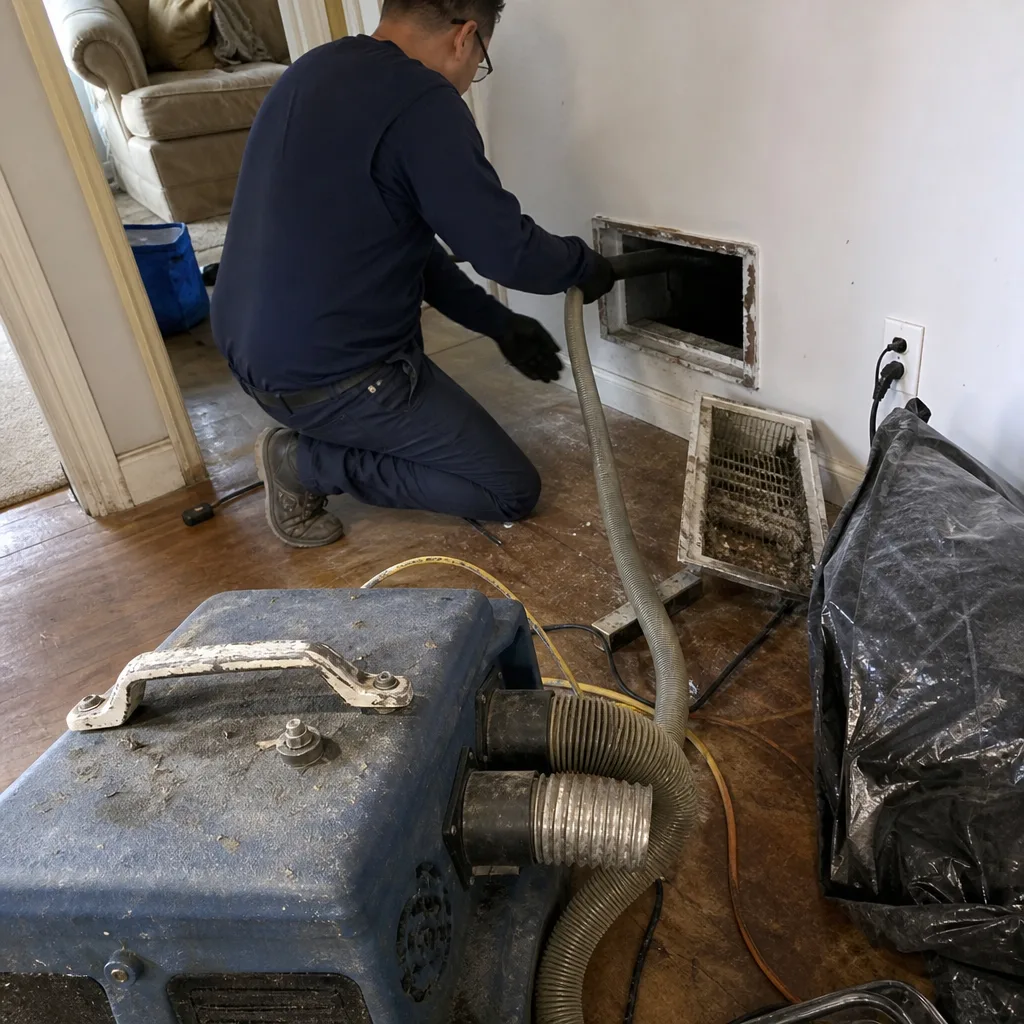
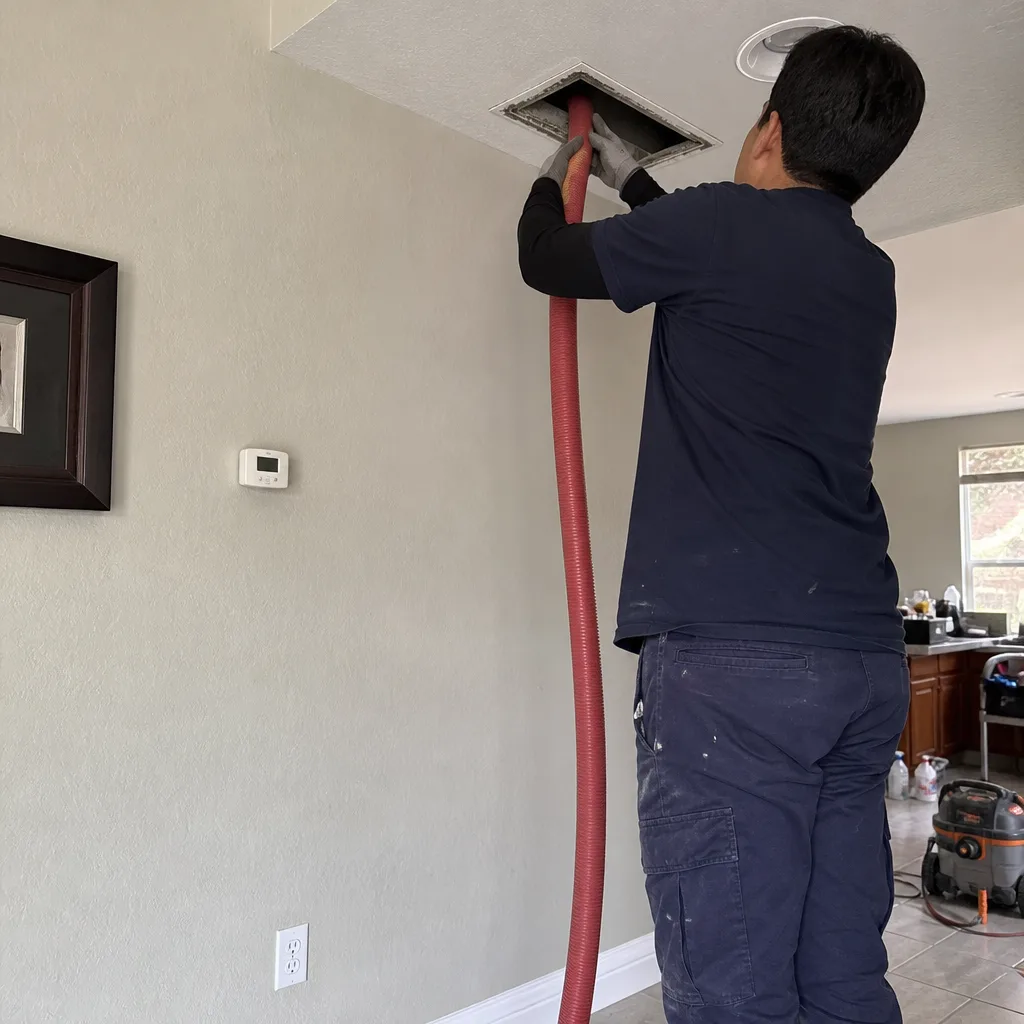
In La Habra, where many homes are on slab foundations with limited crawl space access, cleaning is often the only intervention that doesn’t require destructive access. That makes the cleaning visit the moment when all questions about chemicals, coatings, and sealants should be asked. Our approach at Cobalt Air Duct Cleaning home is to use mechanical agitation and vacuum extraction with Rotobrush and Nikro equipment, which removes contaminants physically rather than chemically. We do not fog, we do not spray antimicrobials into duct interiors, and we explain why to any homeowner who asks. The best cleaning removes material; it does not add chemistry to the system.
Mold in Ductwork: When Cleaning Becomes Remediation
Mold changes the regulatory picture completely. If a visual inspection or a cleaning reveals visible mold growth inside your ductwork, you are no longer in the cleaning category. You are now in the remediation category, and remediation triggers a different set of standards, disclosures, and requirements.
The key framework comes from the EPA’s document “Mold Remediation in Schools and Commercial Buildings,” which is widely referenced as the baseline guidance for all mold remediation work, including residential. Cal/OSHA’s Aerosol Transmissible Diseases standard (Title 8, Section 5199) governs worker protection during mold removal. Neither document requires a specific “mold license” in California – the state does not issue one – but both establish the work practices that define a defensible remediation: containment of the affected area, HEPA-filtered negative air pressure, removal of contaminated materials, and post-remediation verification.
For ducts specifically, the question is whether the mold is on removable duct liner, on the sheet metal itself, or on flex duct that can be replaced. Surface growth on sheet metal can sometimes be cleaned with HEPA vacuuming and mechanical agitation. Growth that has penetrated fiberglass duct liner is different: the liner is the problem, not the surface, and removal or replacement is the standard remedy. Growth inside flex duct is the simplest call: replace the duct. A company using Abatement Technologies HEPA equipment is equipped to handle containment and air scrubbing during mold-related duct work, which matters because mold spores are 1 to 30 microns and require HEPA filtration to capture. Standard vacuum equipment without HEPA filtration simply redistributes spores through the exhaust.
La Habra’s coastal-influenced climate, despite its inland position, still carries the marine layer’s morning humidity, and homes without adequate attic ventilation trap that moisture in duct runs. The result is that mold inside ducts is a recurring finding in the area, particularly in systems that have not been cleaned in a decade or more. When we find mold during a cleaning visit, we stop and tell the homeowner exactly what we’re seeing. Remediation is not a cleaning service with extra steps; it is a separate scope with separate protocols. A homeowner deserves that distinction spelled out clearly before any work continues.
Property Disclosure: What You Must Tell a Buyer About Duct Work
California Civil Code Section 1102 requires sellers of residential property to complete a Transfer Disclosure Statement (TDS) that includes any material facts affecting the value or desirability of the property. Duct work, permits, and repairs fall under this requirement, and the standard California Association of Realtors TDS form includes a specific line for “alterations, repairs, or additions” made to the property. If you have had your ducts repaired, replaced, or modified, and you do not disclose it, you are exposed to post-sale liability.
What does disclosure actually look like in practice? If your ducts were cleaned, you generally have nothing to disclose. Cleaning is maintenance, and maintenance history is not a material fact requiring disclosure. If your ducts were repaired, and the repair was permitted and inspected, you should disclose it with the permit number and inspection date. This is straightforward and adds no burden to the sale. If your ducts were repaired without a permit, you have a material fact on your hands, and failing to disclose it is a violation of the seller’s disclosure obligations. The home inspection process will likely surface the unpermitted work anyway, because home inspectors in Orange County are trained to look for duct repairs that don’t match the surrounding system’s age and character.
There is a second disclosure angle that few guides cover: the presence of noncompliant duct sealing or insulation. Title 24 energy compliance requires that ductwork in specific climate zones meet minimum insulation values. If your ducts were repaired or replaced without the required insulation or sealing, the work may be noncompliant even if it was permitted. A thorough disclosure includes the specifics of what was done and to what standard.
For La Habra sellers specifically, the city’s strong home resale market means buyers are represented by agents who know the local inventory well. A home with duct work that can be documented as cleaned, repaired with permits, and inspected will sell more cleanly than one with a vague history and visible signs of recent duct activity. The documentation is not just a legal obligation; it is a market advantage. A permitted Air Duct Repair in La Habra is a selling point because it removes the buyer’s uncertainty.
Common Mistakes to Avoid
- Assuming any duct work is “just cleaning.” If a technician reattaches, reseals, or replaces anything during your cleaning, it is a repair under the CMC, and it requires a permit. Ask for one. A company that cannot produce a permit number for that work is operating outside the C-20 framework.
- Hiring a non-licensed company for repair work. Cleaning companies without a C-20 license are common in Orange County, and they survive because most homeowners never ask. The CSLB website lets you verify a license in 30 seconds. Use it.
- Letting an unpermitted repair stay undocumented until you sell. The repair does not get more legal because years passed. When the home inspection finds it, you will either disclose it late or negotiate from weakness. Pull the permit retrospectively if you inherited an unpermitted repair.
- Allowing biocide sprays or “sanitizing fogs” without question. The EPA has not registered any product for interior duct application. If a company is spraying something into your ducts, ask for the EPA registration number and the product’s California VOC classification. Most will not be able to produce either.
- Treating mold as a cleaning issue. Visible mold in ductwork is remediation, not cleaning. It requires containment, HEPA air scrubbing, and a different protocol. Attempting to clean mold out of ducts with standard equipment redistributes spores through your living space.
- Choosing the lowest bid without checking what it includes. In La Habra, duct cleaning bids range from $300 to $800 for a typical single-family home. A bid at $150 is not a better deal; it is a different service, often a “blow and go” that uses a compressed air wand and a shop vac. The labor, equipment, and time requirements for a real cleaning are consistent across companies.
When to Call a Professional
If you see dust accumulating on your registers within days of cleaning your home, or if you notice visible dust streaks on your walls near vents, your ductwork is talking to you. If any room in your La Habra home is consistently warmer than the others despite balanced vents, you may be looking at a disconnected or leaking duct in the attic. If you smell musty air when the system first kicks on, that’s often microbial growth inside the ducts or the evaporator coil. And if you peek into your duct with a flashlight and see matting, debris, or anything that looks like textile fibers, that’s contamination that a cleaning will address and a repair may prevent from returning. Cobalt Air Duct Cleaning offers free estimates in La Habra – call (866) 596-7835.
Frequently Asked Questions
No. Air duct cleaning is classified as maintenance, not construction, and California does not require a permit for cleaning services that do not alter the duct system. A permit becomes necessary when the work transitions into repair, replacement, or modification of ductwork. Call (866) 596-7835 if you want to know which category your project falls into – the answer is usually clear from the scope of what needs to happen.
For a typical single-family home in La Habra, expect to pay between $350 and $650 for a complete duct cleaning that includes all supply ducts, return ducts, and the main trunk line. Homes with multiple systems, extensive flexible duct runs, or significant contamination may run higher. Any quote dramatically below this range is not for the same service. Call (866) 596-7835 for an exact quote – estimates are free.
Because the cheaper companies are not doing the same work. A $99 duct cleaning special is typically a “blow and go” service: a technician opens one register, runs a compressed-air wand for a few minutes, and leaves. A real cleaning uses mechanical agitation brushes (like Rotobrush and Nikro systems) that physically scrub the duct walls, combined with powerful vacuum extraction that runs through the entire system. The labor, equipment, and time are entirely different, and the price reflects that. Call (866) 596-7835 and ask what equipment we use; the answer tells you everything.
Before-and-after photos of your ducts are the most reliable verification. A real cleaning will produce clear images of the duct interior before the work, showing the dust and debris, and after the work, showing clean sheet metal. If a company cannot provide before-and-after photos of your own system, you have no verification. We take before-and-after photos on every Air Duct Cleaning in La Habra job and show them to the homeowner before we leave.
No. Title 24 duct leakage testing applies to new duct installation and replacement, not cleaning. If your cleaning reveals that your ducts need replacement, then Title 24 testing requirements attach to the replacement work. This is one of the reasons the cleaning-versus-repair distinction matters as much as it does – the code obligations change entirely depending on which service you need. Call (866) 596-7835 for a free estimate that will tell you which path applies to your home.
Only if that company holds a C-20 Warm-Air Heating, Ventilating and Air-Conditioning Contractor license and pulls a mechanical permit for the repair work. A company without the C-20 license that performs a repair during a cleaning is operating outside California contractor law, and the repair is unpermitted. Ask for the license number before any repair work begins. You can verify it on the CSLB website in seconds.
For most La Habra homes, every 3 to 5 years is a reasonable interval. Homes with pets, smokers, recent remodeling, or residents with significant allergies may benefit from more frequent cleaning. Homes with newer construction and aggressive filtration may go longer. The honest answer is that the interval depends on what’s actually inside your ducts, which is why a visual inspection is the starting point for any legitimate recommendation. Call (866) 596-7835 for a free inspection and we’ll show you what we find.
No. Dryer Vent Cleaning in La Habra is classified as maintenance, like duct cleaning, and no permit is required. However, if the vent run needs to be replaced because of damage, improper materials, or code violations, that replacement falls under the same mechanical permit framework as duct repair. Many La Habra homes have flexible foil dryer vents that are not code-compliant; replacing those requires a permit and a rigid metal vent installation.
The Bottom Line
California’s regulatory framework for ductwork is not complicated once you separate cleaning from repair. Cleaning needs no permit, no C-20 license, and no inspection. Repair, replacement, and modification need all three, plus Title 24 compliance if the replacement qualifies. The risk for homeowners comes from companies that blur this line, performing repairs under the banner of cleaning without permits or licenses. In La Habra, where older homes and hot attics put duct systems under real stress, the distinction matters more than most homeowners realize. Ask about the C-20 license. Ask about permits. Ask to see what’s inside your ducts. And keep the documentation, because it follows the home long after the work is done.
Written by the team at Cobalt Air Duct Cleaning, serving La Habra since 2016.
See the difference
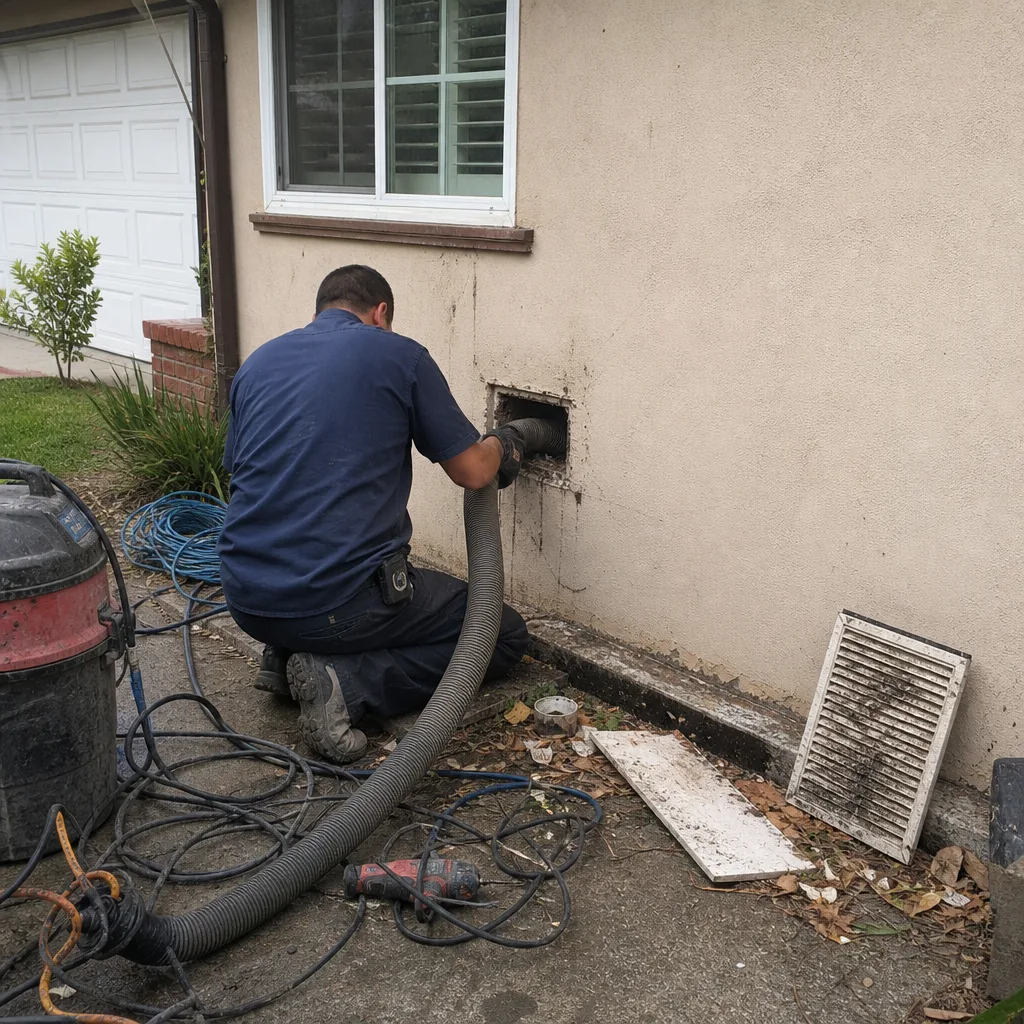 Before
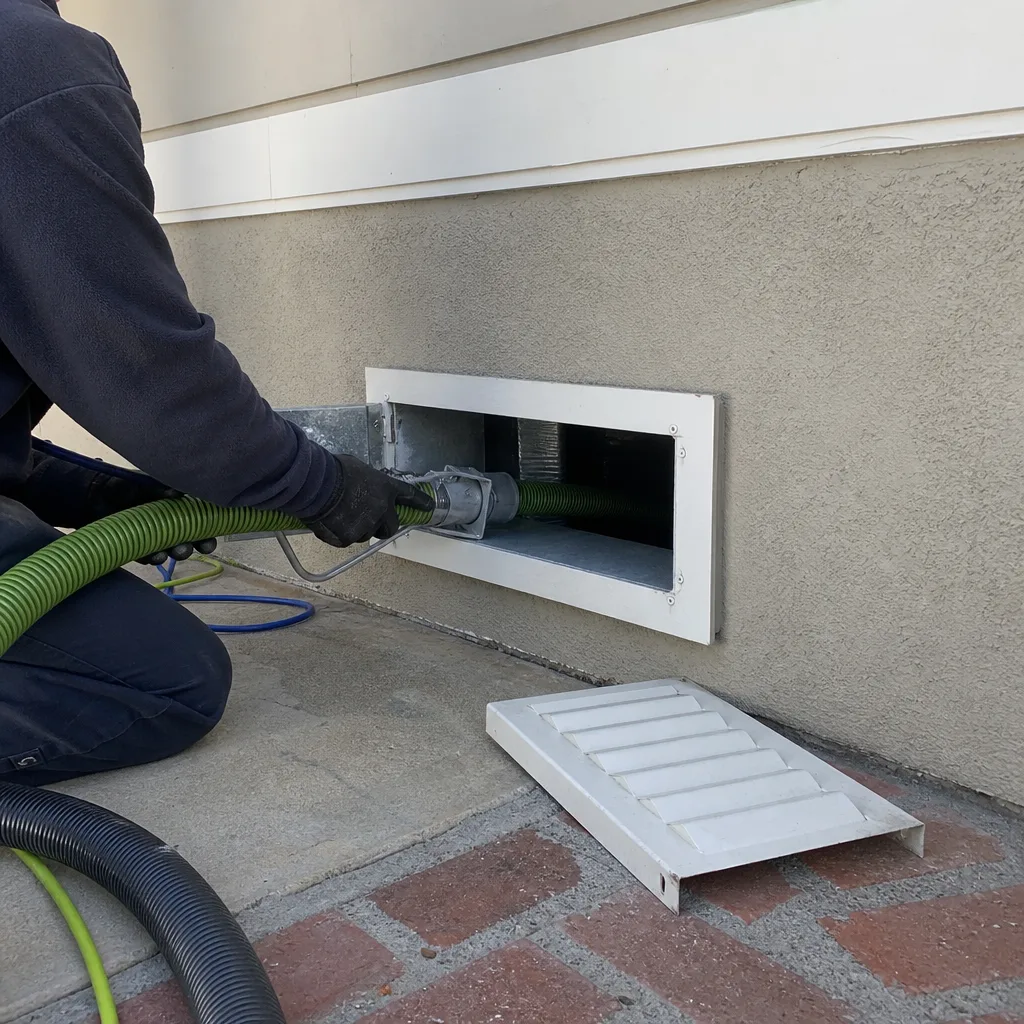 After
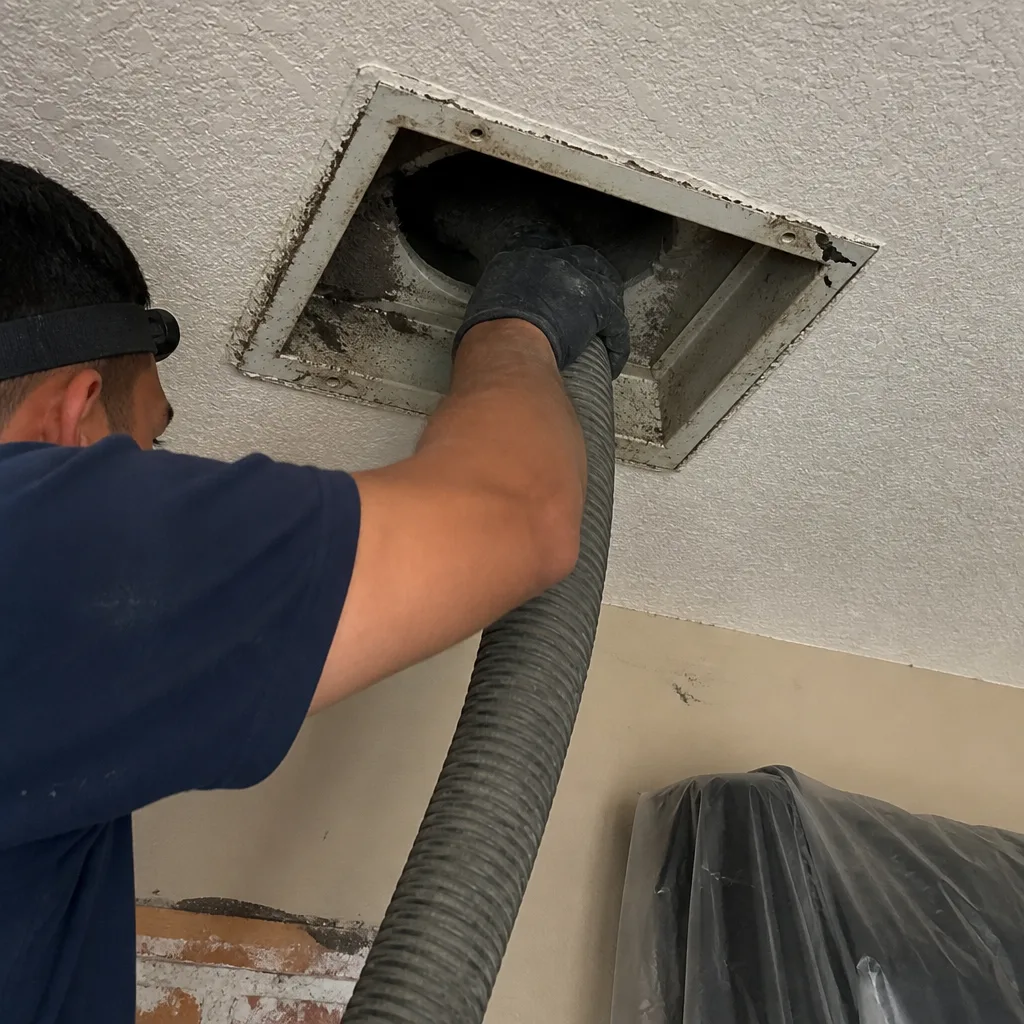 Before
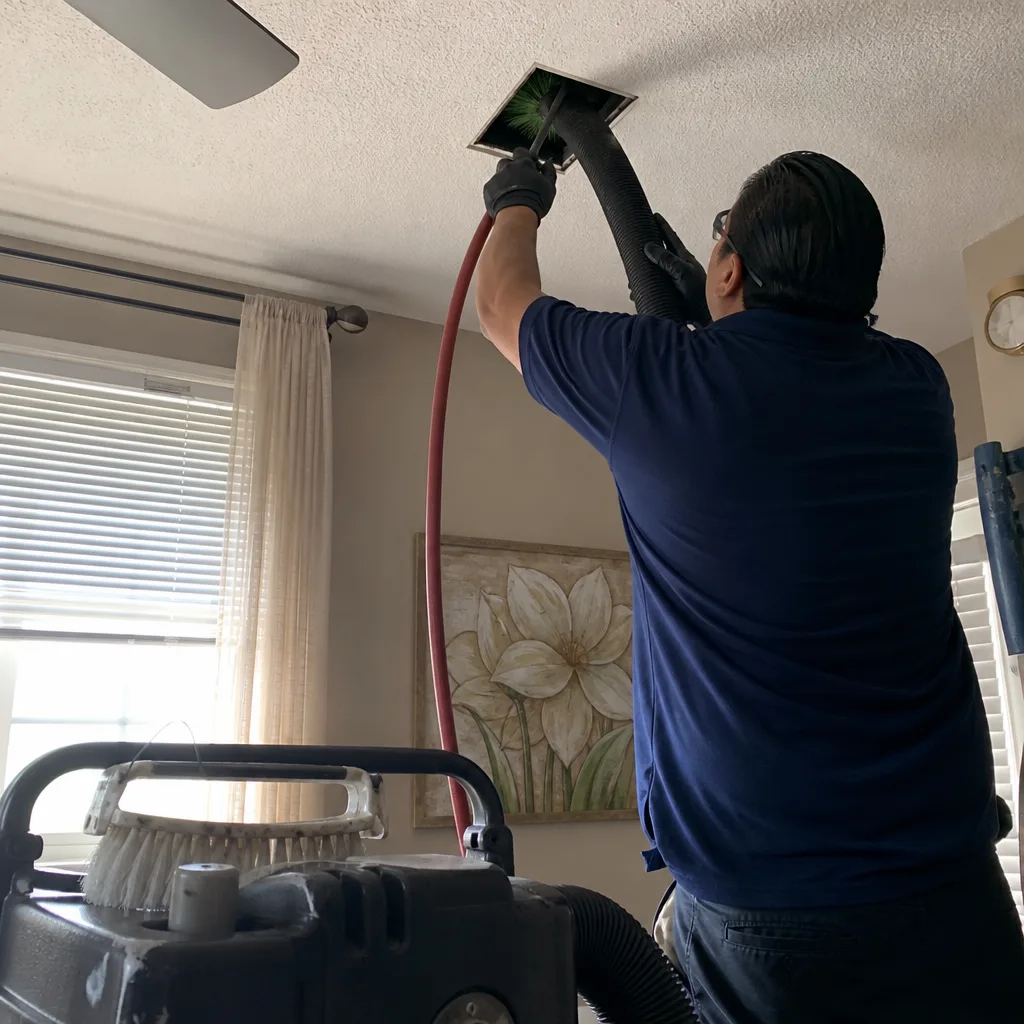 After
 Before
 After